Branded Residences Are Not Failing in NCR. Wrong Product Market Fit Is.
All Ten NCR Branded Residences, Checked on key paramters, absorption bands and global price benchmarks. What separates the sellouts from the slow starts. Are Branded Residences worth the premium and by how much?

At a Glance
Ten projects, one completed cycle. Trump Towers Delhi NCR is the only branded residence to go from launch to sellout to possession has given 127% appreciation, compounding at 10.8% annually.
The operator-vs-licence split Every project with a disclosed hospitality operator has performed. Every project where the operator is undisclosed is still waiting.
Carpet efficiency inverts the headline. A buyer at M3M The Cullinan II pays ₹76,521 per sqft of carpet. A buyer at Trump Towers, ready to move, pays ₹54,478 lower than Trump Residences 2.0 (₹55,970)
NCR's top end now touches Global benchmarks. On a carpet-area basis, Sector 94 Noida sits above Trump Towers Chicago.
Ten branded residences have launched across Delhi NCR since 2018. Five have received a solid response. Three have been average. Two are moving slowly. Only one has completed a full cycle from launch to possession to resale.
That is the entire evidence base for a category that Buyers, developers, and channel partners are currently discussing as the most desirable thing you can own in NCR. But is every branded residences worth the money?
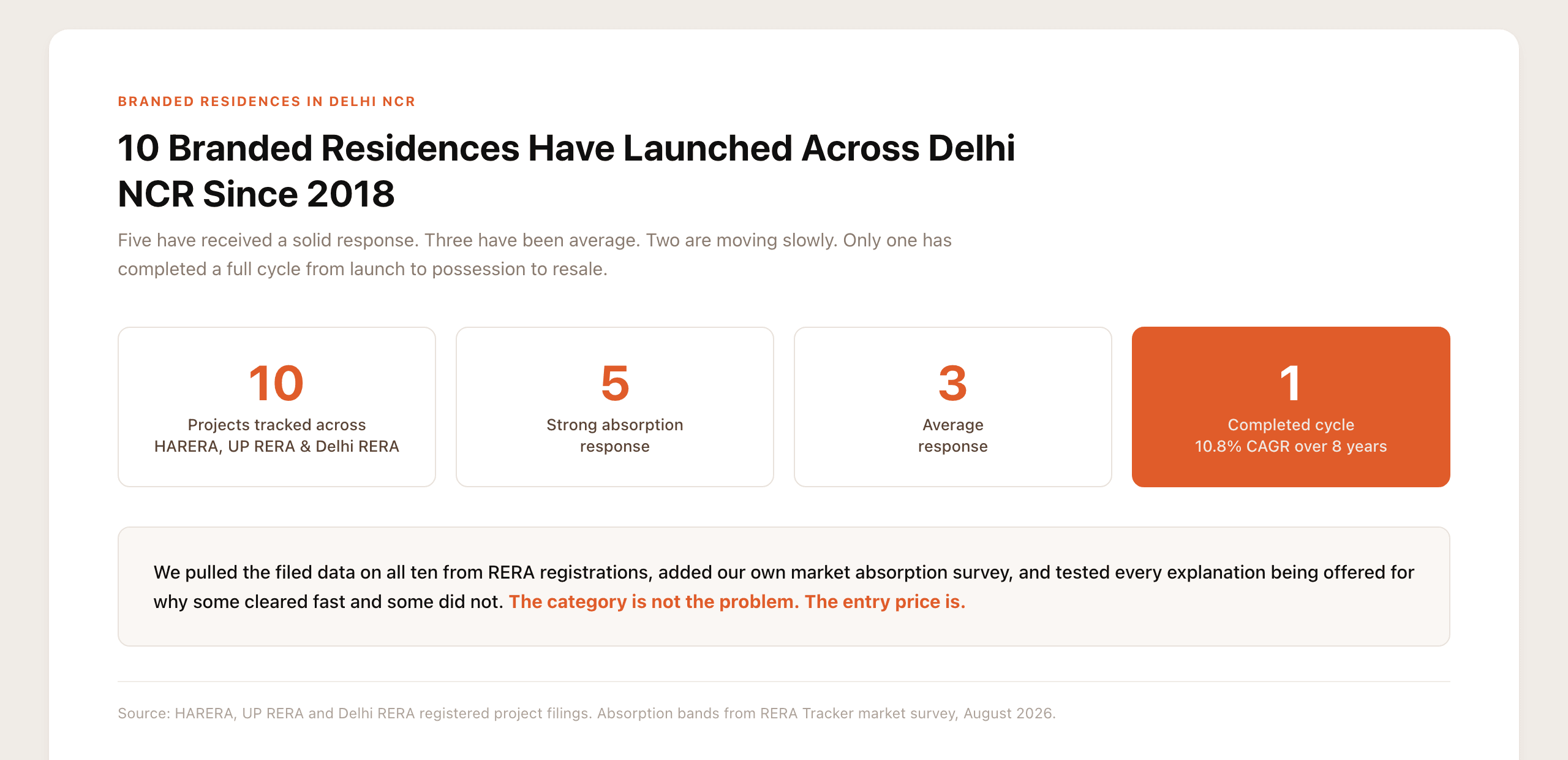
We pulled the data on Ten branded residences projects across Gurgaon, Noida and Delhi, verified data and added our own market absorption survey, and then tested every explanation being offered for why some cleared fast and some did not. Location. Brand. Product. Price. The four variables that decide every real estate outcome, branded or otherwise. For this category also included two other parameters: Hospitality and Exclusivity.
Below you will see who passes the test and who doesn't. Nothing here is a failure. Most of these projects are five to seven years from possession and have every opportunity to price, service and deliver their way into a different outcome. What the data shows is what the market is reading today, at launch, before a single service standard has been tested.
The category is not the problem. The entry price is.
The Ten Projects
| Project | Corridor | Launch | Launch ₹/sqft | Current ₹/sqft | Carpet efficiency | Units | Absorption |
|---|---|---|---|---|---|---|---|
| Trump Towers Delhi NCR | GCER, Sector 65 | May 2018 | 15,000 | 34,000 | 62.4% | 258 | Sold out |
| The Westin Residences by Whiteland | Dwarka Expressway, Sector 103 | Jun 2024 | 22,000 | 26,000 | 52.5% | 1,464 | 50-75% |
| Trump Residences Gurgaon | SPR, Sector 69 | Jan 2025 | 25,000 | 30,000 | 53.6% | 298 | 75-100% |
| M3M Elie Saab at SCDA | Dwarka Expressway, Sector 111 | Oct 2025 | 35,000 | 37,000 | 48.8% | 336 | 0-25% |
| Tonino Lamborghini Residences | SPR, Sector 71 | Apr 2026 | 22,000 | 23,000 | 54.5% | 812 | 25-50% |
| Gulshan The G (Taj Residences) | Noida Expressway, Sector 129 | 2024 | 25,000 | 30,000 | Not disclosed | 74 | 25-50% |
| M3M The Cullinan II (Trump Towers) | Noida, Sector 94 | 2025 | 35,000 | 36,500 | 47.7% | 156 | 50-75% |
| M3M Jacob & Co | Noida, Sector 97 | 2025 | 32,000 | 32,000 | 49.7% | 258 | 50-75% |
| Smartworld Elie Saab | Noida, Sector 98 | Oct 2025 | 30,000 | 30,000 | 48.0% | 399 | 0-25% |
| Trident Residences | Jangpura Extension, South Delhi | 2020 | Not disclosed | Not disclosed | Not disclosed | 19 | 75-100% |
Let's start with two projects in the same micro-market - Dwarka Expressway
The Westin Residences by Whiteland launched on Dwarka Expressway in June 2024 at ₹22,000 per square foot. It has cleared around 50-75% of its 1,464 units, the largest volume of branded residential absorption anywhere in NCR.
M3M Elie Saab at SCDA launched on the same Dwarka Expressway in October 2025 at ₹35,000 per square foot. Sixteen months later, 59% higher on the same corridor. It has cleared lessor than 25% of 336 units.
Same micro-market, Same buyer pool. One is a Marriott operating agreement, the other is a couture naming licence. The market priced the difference and has rewarded it accordingly. This is what we call a wrong Product Market Fit
What "Product Market Fit" Means Here?
A branded residence just like regular real estate has product market fit when the location, the brand, the product and the price point are aimed to a particular buyer. A ₹10 crore apartment sold to a ₹10 crore buyer with a brand that buyer recognises and a service layer that buyer will use. Break any one of the four and the other ones also stop working.
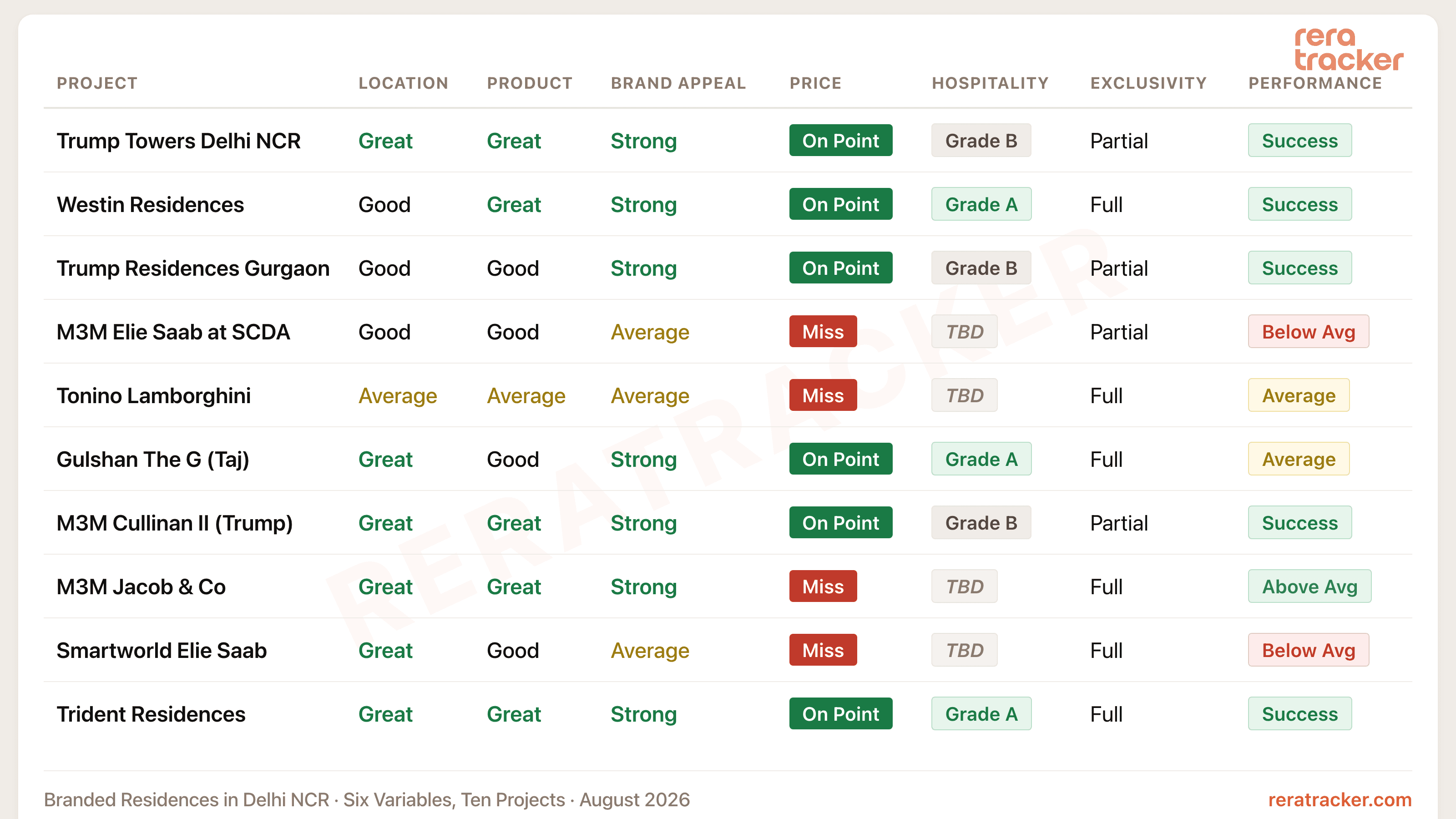
Through data we ran a qualitative assessment across six parameters for all ten branded residences projects. This grid makes the pattern visible: Why some have performed well and why some have done poor (All of them have a Product Market Fit problem)
| Project | Location | Product | Brand Appeal | Price | Hospitality | Exclusivity | Performance |
|---|---|---|---|---|---|---|---|
| Trump Towers | Great | Great | Strong | On Point | Grade B | Partially Exclusive | Success |
| The Westin Residences by Whiteland | Good | Great | Strong | On Point | Grade A | Fully Exclusive | Success |
| Trump Residences Gurgaon | Good | Good | Strong | On Point | Grade B | Partially Exclusive | Success |
| M3M Elie Saab at SCDA | Good | Good | Average | Miss | Yet to be revealed | Partially Exclusive | Below Average |
| Tonino Lamborghini Residences | Average | Average | Average | Miss | Yet to be revealed | Fully Exclusive | Average |
| Gulshan The G (Taj Residences) | Great | Good | Strong | On Point | Grade A | Fully Exclusive | Average |
| M3M The Cullinan II (Trump Towers) | Great | Great | Strong | On Point | Grade B | Partially Exclusive | Success |
| M3M Jacob & Co | Great | Great | Strong | Miss | Yet to be revealed | Fully Exclusive | Above Average |
| Smartworld Elie Saab | Great | Good | Average | Miss | Yet to be revealed | Fully Exclusive | Cancelled |
| Trident Residences | Great | Great | Strong | On Point | Grade A | Fully Exclusive | Success |
Variable One: Location Does Not Separate the Sample
Five projects carry a Great location rating, yet their outcomes range from Success to Below Average.
Smartworld Elie Saab sits in Sector 98 Noida, on the Expressway, with the corridor's infrastructure already built out. It still couldn't clear more than 25% of 3 & 4 BHK apartments (leaving studios aside). Interestingly the developer has now decided to recalibrate the sizes with even larger sized apartments.
M3M Jacob & Co is in Sector 97, just adjacent, has cleared 50-75% and could absorb all inventory of larger sizes. Gulshan The G is on a 2.56 acre parcel in Sector 129 with 74 units in a single 56 floor tower, which is 29 units per acre and the second lowest density in the entire sample.
Meanwhile The Westin Residences by Whiteland carries only a Good location rating. Sector 103 on Dwarka Expressway, a corridor still waiting to address the rich folks of Gurgaon / Delhi. It has cleared ~50-75% of 1,464 units, which in absolute terms is the largest volume of branded residential absorption anywhere in NCR by a wide margin.
So when it comes to Ultra Luxury apartments...Location does matter but it clearly does not decide.
Variable Two: Brand Appeal Does Not Separate the Sample Either
This is where it gets interesting. Seven projects carry strong brand appeal. Two of those seven are not Successes. Gulshan The G carries the Taj name, arguably the strongest hospitality brand in Indian residential real estate, and is rated average. M3M Jacob & Co carries a name any watch collector in the world recognises instantly, and is rated above average, not Success.
Brand appeal does point in the right direction. All three projects rated average on brand appeal are among the four slowest movers. But it produces exceptions in the other direction, and exceptions mean it is also not the single most deciding variable. Inside the brand question there is a sharper factor to analyze and it is the finding that holds this entire piece together.
Variable Three: Hospitality Partner: Who Runs the Building Matters More Than Who Named It
Six projects brought an operator with a disclosed hospitality grade: Trump Towers (Grade B), The Westin Residences (Grade A), Trump Residences Gurgaon (Grade B), Gulshan The G (Grade A), M3M The Cullinan II (Grade B), Trident Residences (Grade A). Five successes, one average.
Licence-backed, hospitality partner yet to be revealed: M3M Elie Saab at SCDA, Tonino Lamborghini Residences, M3M Jacob & Co, Smartworld Elie Saab. Four Projects that haven't gotten above average response.
Split the ten projects by whether the brand brings a hospitality operator or a naming licence.
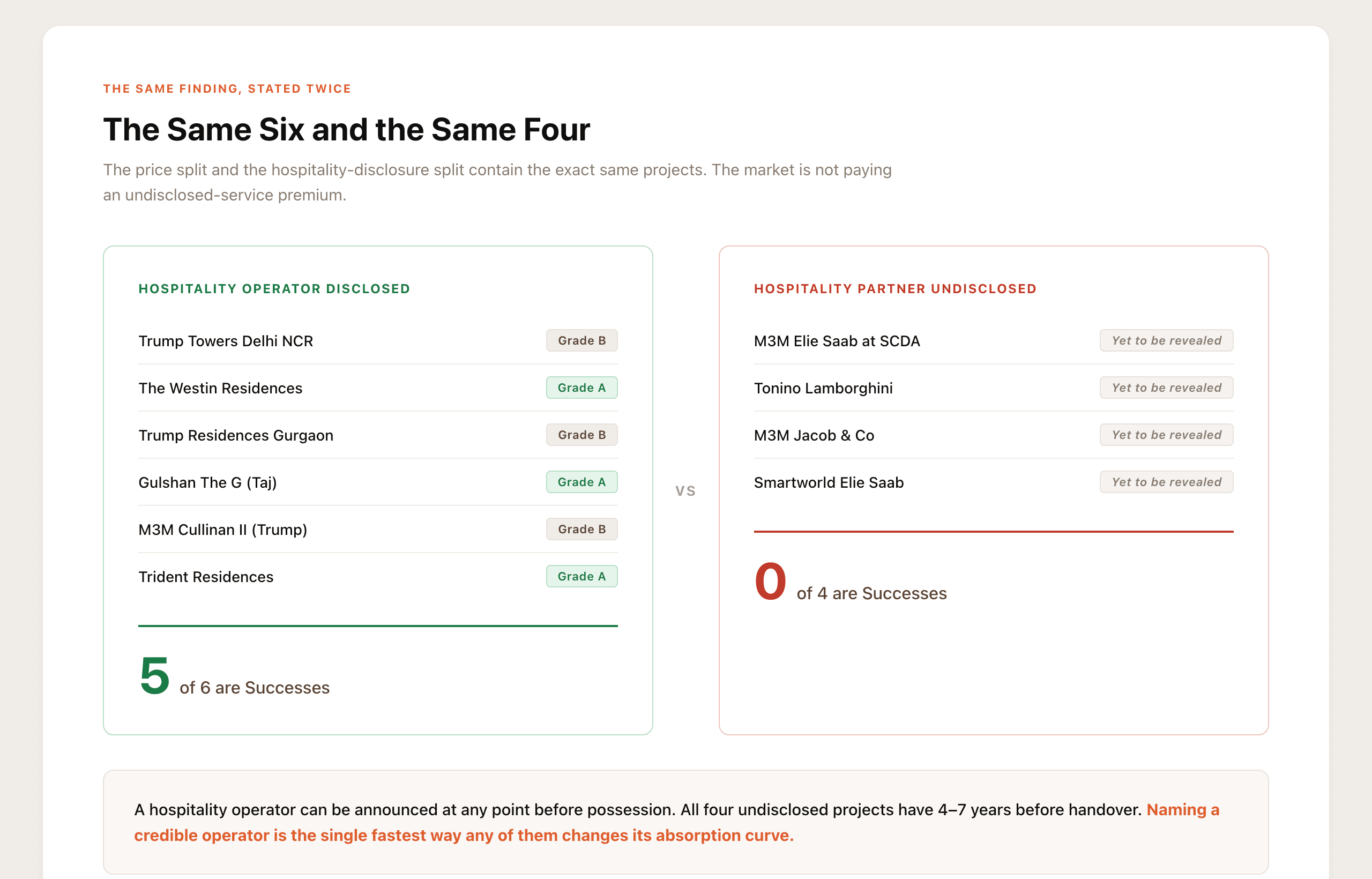
Now this gives a great insight and the pattern becomes clean. Every NCR branded residence with a named hospitality operator has performed. Every project where the operator remains undisclosed has not. And the reason is not optics.
When a developer signs Westin, it signs Marriott International. Marriott brings a service standard, a global reservation and loyalty infrastructure, an operating agreement with performance obligations, and staff trained to a manual that exists in 140 countries. The brand fee buys an operating system.
When a developer signs a couture house, a jeweller or an automotive lifestyle label, it signs a design and naming licence. The brand supplies a mood board, a materials palette, a logo on the gate and a launch event. It supplies no housekeeping standard, no concierge protocol, no front-of-house training, no reservations system, and no accountability for the resident's daily experience five years after possession.
**Both are legitimate commercial structures but they are not the same product and the market is not currently pricing them as the same product and that's where one has to be selective. ** Crucially, this is fixable and several of these projects still can fix it. A hospitality operator can be announced at any point before possession. The four projects currently rated Below Average, Average and Above Average all have between four and seven years before handover. Naming a credible operator, on a disclosed operating agreement, is the single fastest way any of them changes its absorption curve.
Smartworld Elie Saab illustrates the harder version of the problem, because its issue is structural rather than contractual. The RERA filing shows 399 units across four towers, of which 196 are studios. A couture house has been attached to a project priced at ₹30,000 per square foot in Sector 98 Noida. Market hasn't responded to compact format living after which the developer is now changing the sizes and will be reapplying rera approvals.
Variable Three: The Actual Product
Luxury is the vaguest word in a sales deck, but a good product requires special attention to detail, it is subjective but through certain parameters it can be measured. Five branded residences carry a great product rating out of which four are successes. Product is the strongest of the three non-price variables, which makes sense. But it still leaves an exception, and the exception is instructive.
Jacob & Co, Noida exception matters. It has Great location, Great product, and Strong brand appeal. On three of six variables it is the second-best project in the sample. It is rated Above Average, not Success, and the only column that reads Miss is price.
Product gets you to the shortlist. It does not close.
Variable Four: Exclusivity Runs the Opposite Way to the Sales Pitch
This is the most counterintuitive line in the grid and for this category it deserves special attention. Four projects are rated Partially Exclusive. Three are Successes: Trump Towers, Trump Residences Gurgaon, M3M The Cullinan II. One is Below Average.
Six projects are rated Fully Exclusive. Two are Successes: The Westin Residences and Trident Residences. The other four are Above Average, Average, Average and Below Average.
Fully exclusive projects are the larger projects. The Westin Residences is fully branded across 1,464 apartments on the other hand Trump Residences is partially branded as it shares area with another Smartworld Skyarc. Both sell the same promise but Exclusivity is the most heavily marketed attribute in this category and, on this sample, the weakest predictor of absorption.
Full exclusivity does not mean the branded thing is rare. It means the entire project carries the brand, so nothing inside the gate is scarce. Partial exclusivity means a branded component sits inside a larger development, which produces a smaller branded cohort, an existing amenity base, footfall from day one, and a non-branded neighbour to price against at resale.
Variable Five: Price, and Only Price, Separates the Sample Cleanly
Return to the grid.
Price rated On Point: Trump Towers, The Westin Residences, Trump Residences Gurgaon, Gulshan The G, M3M The Cullinan II, Trident Residences. Six projects. Five Successes, one Average.
Price rated Miss: M3M Elie Saab at SCDA, Tonino Lamborghini Residences, M3M Jacob & Co, Smartworld Elie Saab. Four projects. Zero Successes.
Location produced exceptions. Brand appeal produced exceptions. Product produced an exception. Exclusivity produced exceptions. Price produced no exceptions in either direction.
The price column and the hospitality-disclosure column contain the same six and the same four projects, the two findings are the same finding stated twice: the market is not paying an undisclosed-service premium.
One caveat on the clean result. Tonino Lamborghini Residences launched in April 2026 and is roughly four months old at the time of writing. Its 25-50% band is early data, not a verdict, and it launched at ₹22,000 into an SPR corridor where that is a defensible number. It belongs in the sample but should be read as provisional.
The Loading Problem Nobody Publishes
Carpet efficiency is the ratio of RERA carpet area to super area. It is important, It is public, yet It is almost never quoted in a sales conversation. Here is what the filings show, sorted by efficiency:
| Project | Carpet efficiency | Current ₹/sqft super | Effective ₹/sqft carpet |
|---|---|---|---|
| Trump Towers Delhi NCR | 62.4% | 34,000 | 54,478 |
| Tonino Lamborghini Residences | 54.5% | 23,000 | 42,210 |
| Trump Residences Gurgaon | 53.6% | 30,000 | 55,970 |
| The Westin Residences by Whiteland | 52.5% | 26,000 | 49,524 |
| M3M Jacob & Co | 49.7% | 32,000 | 64,335 |
| M3M Elie Saab at SCDA | 48.8% | 37,000 | 75,804 |
| Smartworld Elie Saab | 48.0% | 30,000 | 62,461 |
| M3M The Cullinan II (Trump Towers) | 47.7% | 36,500 | 76,521 |
The cleanest performers sit at 62.4%, 53.6% and 52.5%. Every project rated Miss on price sits at 54.5% or below, with three of the four at under 50%.
Put plainly: in NCR, the more expensive the branded residence, the less measured living space the buyer receives per rupee. A buyer at Trump Towers Noida is paying ₹76,521 per square foot. On a carpet-area basis, it sits above Trump Towers Chicago!
The Global Comparison Everyone Gets Backwards
Manhattan quotes net interior area. Singapore quotes strata area. Dubai quotes suite or gross area. NCR quotes super area, which in this sample sits at roughly half the carpet. Which makes the comparison wrong, and it is wrong because of the area basis. So we restate every market on the closest available usable-area basis, name the actual comparable projects, and put both currencies side by side.
| Project or benchmark | City | USD per sqft | ₹ per sqft | Area basis |
|---|---|---|---|---|
| Aman New York, 730 Fifth Avenue, 22 residences (resale band) | Manhattan | 8,000 to 11,400 | 7.62 to 10.86 lakh | Net interior |
| Baccarat Hotel & Residences, Downtown (record pre-construction trade, AED 14,000) | Dubai | 3,812 | 3.63 lakh | Suite/gross |
| Four Seasons Private Residences, 157 residences (average) | Manhattan | 3,198 | 3.05 lakh | Net interior |
| Bulgari Resort & Residences, Jumeirah Bay Island (current listings, AED ~11,500) | Dubai | 3,131 | 2.98 lakh | Suite/gross |
| Luxury condo average, top decile | Manhattan | 2,968 | 2.83 lakh | Net interior |
| Core Central Region new launch average (S$3,208) | Singapore | 2,468 | 2.35 lakh | Strata |
| Downtown Dubai average (AED 3,011) | Dubai | 820 | 78,124 | Suite/gross |
| M3M Trump Towers | Noida | 803 | 76,521 | RERA carpet |
| M3M Elie Saab at SCDA, Sector 111 | Gurugram | 795 | 75,804 | RERA carpet |
| Mercedes-Benz Places by Binghatti, Meydan (from AED 2,750) | Dubai | 749 | 71,352 | Suite/gross |
| M3M Jacob & Co, Sector 97 | Noida | 675 | 64,335 | RERA carpet |
| Smartworld Elie Saab, Sector 98 | Noida | 655 | 62,461 | RERA carpet |
| Trump Towers Delhi NCR, Sector 65 (ready to move) | Gurugram | 572 | 54,478 | RERA carpet |
Four things fall out of this table.
Sector 94 Noida is now within touching distance of Downtown Dubai. M3M Trump Towers at ₹76,521 per square foot of carpet sits below Downtown Dubai's ₹78,124 average. Downtown Dubai has the Burj Khalifa, an operational metro, zero capital gains tax, deep secondary liquidity, and roughly 80 branded schemes delivered or under construction. It does mean the "cheap by global standards" argument no longer applies to it.
Gurugram Sector 111 is priced above a Mercedes-Benz branded launch in Dubai. M3M Elie Saab at SCDA at ₹75,804 carpet sits above Mercedes-Benz Places by Binghatti in Meydan at ₹71,352 entry. Same brand-licence structure, same off-plan stage, different city.
Against the true global top end, real headroom remains, and honest analysis should say so. Even at ₹76,521 carpet, NCR sits at about a quarter of Manhattan's luxury average and a tenth of Aman New York. Bulgari on Jumeirah Bay is nearly four times Sector 94, Noida. The issue is not that NCR is expensive against Dubai. It is that NCR is no longer cheap against the markets competing for the same NRI and HNI cheque.
What the Global Data Says the Premium Should Be
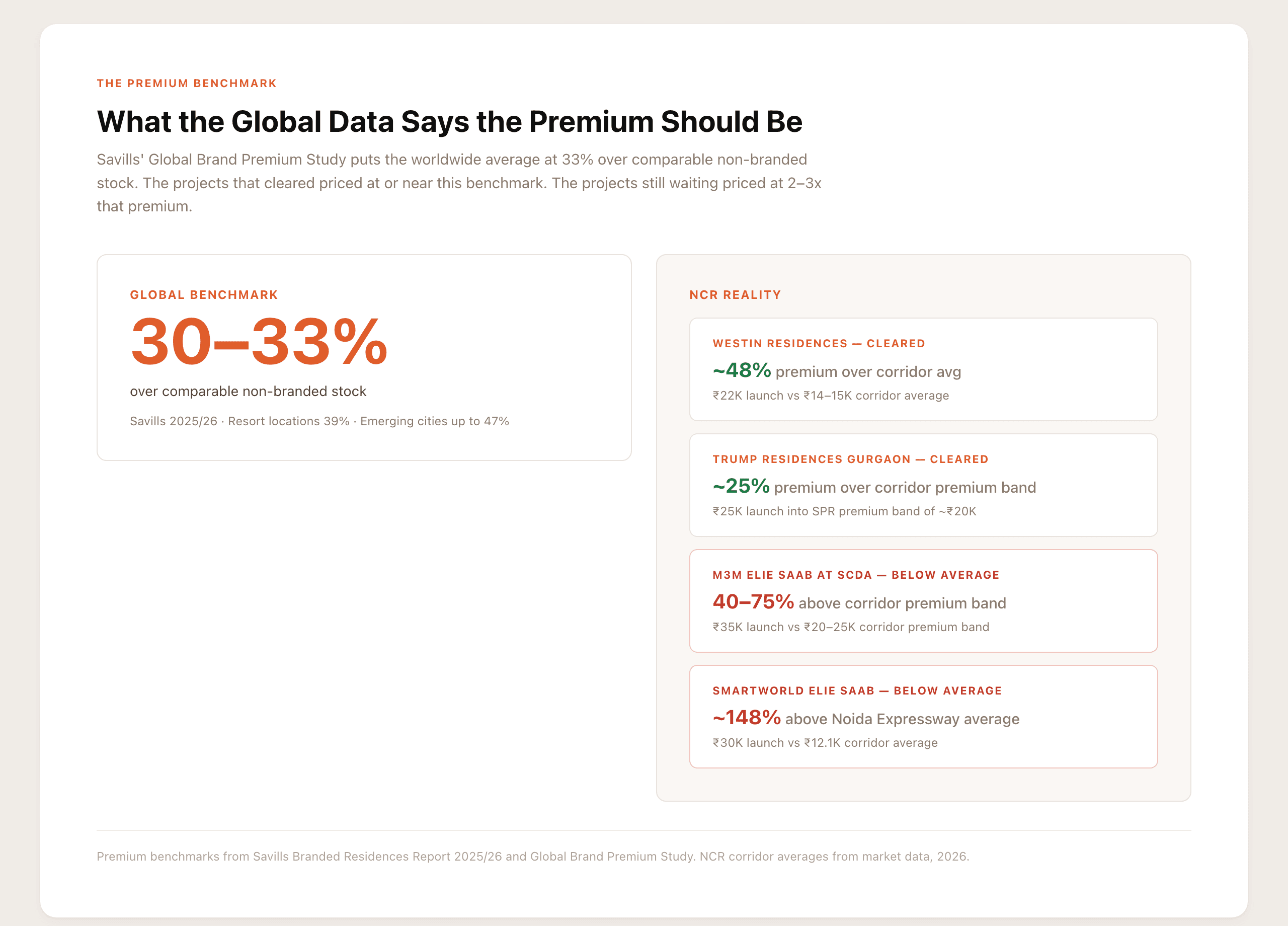
Savills' Global Brand Premium Study puts the worldwide average branded premium at 33% over comparable non-branded stock. Resort locations run highest at 39%. Established and emerging cities both average 30%. In emerging cities specifically, the study records premiums reaching as high as 47% in the strongest cases. Dubai's own branded stock has outperformed comparable unbranded inventory by 25 to 40% on price per square foot.
Now set the NCR launches against their own corridor benchmarks.
Dwarka Expressway average flat rates in 2026 sit around ₹14,000 to ₹14,800 per square foot, with premium new launch product in the ₹20,000 to ₹25,000 band. The Westin Residences launched at ₹22,000 into that corridor. Inside the band, which is why it cleared over a thousand units.
M3M Elie Saab at SCDA launched at ₹35,000 into the same corridor. Against a premium new-launch benchmark of ₹20,000 to ₹25,000, that is a premium of 40 to 75%. Against the corridor average, well over 100%.
Noida Expressway averages roughly ₹12,100 per square foot in 2026. Smartworld Elie Saab launched at ₹30,000 in Sector 98.
The projects that cleared priced at or near the global 30 to 33% branded premium against their own micro-market. The projects still waiting priced at two to three times that premium. The global data does not say branded residences command whatever the brand can extract. It says roughly a third more than the neighbour, and NCR's own results confirm it.
What the Market Is Actually Saying
Four consistent themes come out of conversations with buyers, brokers and family offices active in this band.
Investors can lap them up initially. End users cannot. This is the single most important sentence in the current cycle. An investor at launch is buying a story, a payment plan and an exit before possession, and the brand is the story. An end user buys real estate first and the branded play second, and only pays the premium if it survives that order of examination. Every project in this sample that cleared fast cleared to buyers who accepted the real estate on its own merits before the logo. Every project still waiting is asking the buyer to accept the logo first. Investor demand can carry a launch. It cannot carry a possession.
They are buying a service layer, not an address. Everyone in this segment already has an address. The buyer considering a branded residence is solving for the friction of running a large home in NCR: staff, maintenance, security, guest handling. Some reports find this same globally, that buyers want the fundamentals executed exceptionally rather than novelty, and that the brand is the invitation and not the conclusion. When the operator is undisclosed at booking, the purchase rationale is unresolved, which is precisely the condition of all four slower launches.
Resale liquidity is the unspoken question. In Dubai and Manhattan, a branded residence resells into a deep institutional and international pool with standardised closing mechanics. In NCR, the resale pool for a ₹20 crore-plus branded apartment is measured in hundreds of buyers nationally, not thousands. Small unit counts amplify this. Nineteen units at Trident Residences. Seventy four at Gulshan The G. A hundred and fifty six at M3M The Cullinan II. Scarcity supports price on the way in and thins the market on the way out.
Everyone can now compute the carpet. RERA carpet area is filed and public. The buyer at this ticket size has an analyst, a CA or a family office running the number. The gap between the ₹36,500 headline and the ₹76,521 carpet reality is not a secret and has not been for some time.
Are Branded Residences Worth the Premium?
At the global benchmark of 30 to 33% above comparable local product, with a named hospitality operator under a disclosed agreement, and with carpet efficiency in line with the corridor: yes, and the NCR evidence supports it. Trump Towers returned 10.8% compounded across a full cycle. The Westin Residences moved over a thousand units into a corridor that had never absorbed luxury at that volume.
At 70 to 100% above the corridor, with no operator disclosed and carpet efficiency under 50%: the market has said not yet, twice, in Gurugram and in Noida, on the same brand.
What is being sold as a branded premium in NCR is often three separate things bundled into one number: a genuine service premium, a genuine scarcity premium, and a licensing fee that buys neither. The first two are worth paying for. The third is not, and the absorption data shows buyers can already tell the difference.
How These Could Still Turn Out, and What to Learn
None of the ten projects is finished. Six of them are five to seven years from handover. The slower launches have more runway than the market is giving them credit for, and there are specific, observable levers that would move them.
Name the operator. All four slower launches share one condition: hospitality yet to be revealed. Announcing a credible operator on a disclosed agreement is the fastest available correction and costs nothing structurally. Every project in this sample with a named grade has performed.
Reprice the remaining inventory rather than the launch price. Developers rarely cut headline rates, but staged releases, revised payment plans and configuration re-cuts achieve the same effect. The projects that cleared launched at 25 to 35% over corridor. That is the target, and remaining inventory can be brought toward it without touching the published rate card.
Fix the configuration mismatch where it exists. A couture-branded project whose largest configuration by count is a studio has a positioning problem no marketing budget solves. Re-cutting the mix, or re-scoping which towers carry the brand, is available before construction locks in.
Publish carpet efficiency at the point of sale. The number is already filed. Volunteering it removes the single most damaging discovery a serious buyer makes late in the process, and turns a liability into a differentiator for anyone above 55%.
Watch what partial exclusivity is telling you. Three of four partially exclusive projects are Successes. Embedding a branded component inside a legible larger development appears to help absorption more than isolating it. That is the opposite of how the format is currently marketed.
And the lesson under all of them: an investor will take the brand on faith at launch. An end user will not. The end user reads location, product and price as real estate first, then decides whether the brand is worth the difference. Any project priced for the investor and delivered to the end user has a gap to close, and the closing window is the years between now and possession.
Conclusion
Branded residences work in NCR. Trump Towers proved it with a completed cycle and 10.8% compounded. The Westin Residences proved it at volume. Trump Residences Gurgaon and M3M The Cullinan II are proving it in progress.
What has not worked is the assumption that a recognisable name is a pricing instrument on its own. Ten projects, five tested variables, and only one of them separated fast absorption from slow. Not location. Not brand appeal. Not product. Not exclusivity. Price, and the disclosed service standard that justifies it.
The category is intact. The pricing discipline is not yet. When the correction comes it will be misread as a failure of branded residences, rather than what it will actually be: a market pricing the difference between an operator and a logo.
Track the filed data yourself. Every project in this analysis has a complete record on RERA Tracker: registered carpet and super areas, tower counts, launch and completion dates, developer entity, and price history. Research. Track. Transact.
For project-level data, developer records or corridor pricing history, contact RERA Tracker on +91 8010 704 704.
Data sources: HARERA registered project filings; UP RERA registered project filings; Delhi RERA registration DLRERA2020P0005; RERA Tracker market survey; Savills Branded Residences Report 2025/26 and Global Brand Premium Study; Dubai Land Department referenced transaction and listing data 2026; URA-referenced Singapore new launch data 2026; published Manhattan condo market data 2026. Currency conversion at ₹95.3 per USD, 4 August 2026. Absorption bands and qualitative ratings reflect RERA Tracker market survey and are indicative.